
Fertility is a complex interaction between age, cycle regularity, ovulation, ovarian reserve, hormonal regulation, sperm quality, general health and many other factors. A single blood test can therefore never provide a complete answer as to whether or when pregnancy will occur. However, it can help you better understand important hormonal foundations and identify possible abnormalities at an early stage.
Especially when trying to conceive, experiencing irregular cycles, not ovulating regularly or wanting more clarity about your reproductive health, a hormone check can provide useful initial orientation.
Typical reasons for a Fertility Check may include: current or planned family building, irregular or absent periods, wanting to know more about your ovarian reserve, preparing for a medical consultation or simply wanting to better understand your reproductive health.
Not every cycle irregularity is automatically caused by hormones. This is exactly why a blood test can help check relevant values in a structured way and then have them medically reviewed.
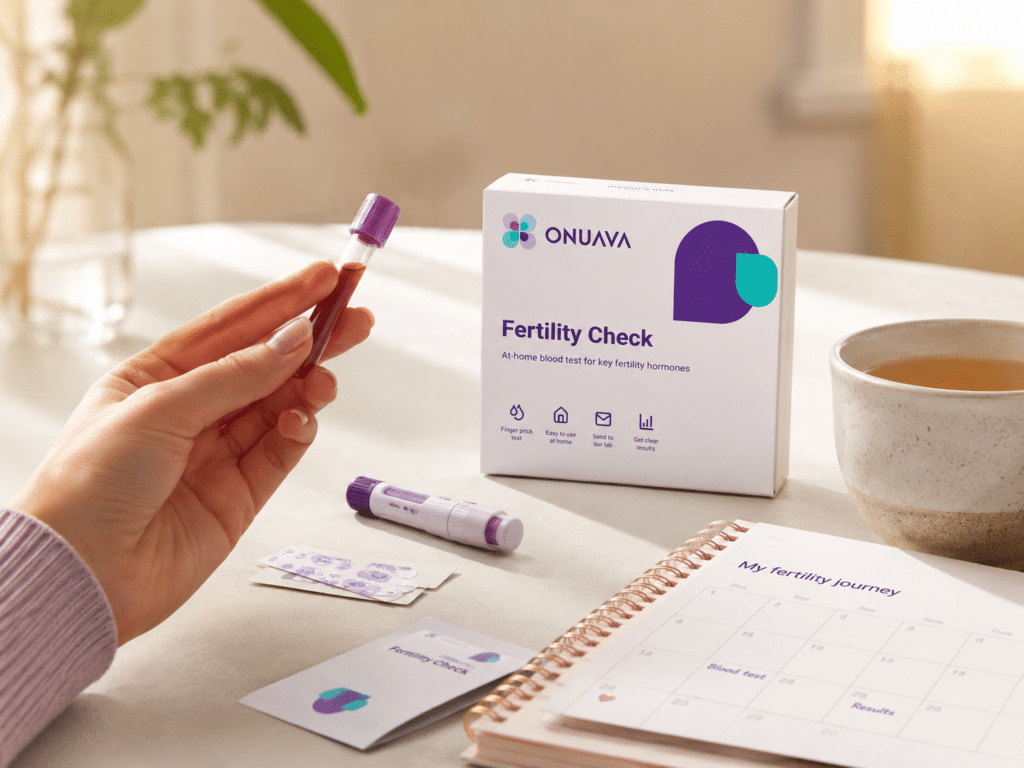
This is where the Onuava Fertility Check comes in. You carry out the test easily at home, and the analysis is then performed in a certified medical laboratory. Once the results are available, you can have your values reviewed by a doctor and discuss which next steps may be appropriate.
What is tested in the Onuava Fertility Check?
The Onuava Fertility Check analyses key blood values that are relevant for the hormonal assessment of fertility. These include markers related to ovarian reserve, hormonal cycle regulation and possible influencing factors around ovulation and trying to conceive.
AMH
AMH stands for anti-Müllerian hormone. It is produced by small developing follicles in the ovaries and is considered an important marker for assessing ovarian reserve.
The AMH value can provide an indication of approximately how many follicles in the ovaries may still be recruitable. However, it does not directly indicate egg quality or whether pregnancy will occur.
A low AMH value may suggest reduced ovarian reserve. An elevated value can occur when there are many small follicles, for example in connection with PMOS. The AMH value should therefore always be considered within the broader medical context.
FSH
FSH stands for follicle stimulating hormone. It is produced in the pituitary gland and stimulates the maturation of follicles in the ovaries.
An elevated FSH value at the beginning of the cycle may indicate that the body needs to stimulate the ovaries more strongly to support egg maturation. This can be a sign of changes in ovarian function.
FSH should ideally be interpreted in relation to the cycle day, oestradiol level and other findings.
LH
LH stands for luteinising hormone. It is also produced in the pituitary gland and plays a central role in ovulation.
A rise in LH normally triggers ovulation. Changes in LH levels can provide information about hormonal cycle regulation.
Together with FSH and oestradiol, LH can help provide a clearer understanding of the cycle and hormonal regulation.
Östradiol E2
Oestradiol is one of the most important female sex hormones and belongs to the group of oestrogens. It is mainly produced in the developing follicles and plays a central role in the menstrual cycle, the build-up of the uterine lining and preparation for possible ovulation.
The oestradiol value can help assess the hormonal activity of the ovaries. It should always be considered in relation to the cycle day and other hormone levels, as oestradiol fluctuates significantly throughout the cycle.
Prolactin
Prolactin is a hormone produced in the pituitary gland. It is best known for its role in breastfeeding, but it can also influence the menstrual cycle and fertility outside pregnancy and breastfeeding.
Elevated prolactin levels can affect ovulation and may be associated with cycle irregularities or absent periods. Stress, certain medications and other physical causes can also influence prolactin levels.
Prolactin is therefore an important additional value when the cycle is irregular or when trying to conceive takes longer than expected.
Why can the Fertility Check be useful?
The Fertility Check can help make important hormonal relationships more visible and support a better understanding of your reproductive health. It does not replace comprehensive fertility diagnostics, but it provides a structured basis for the subsequent medical consultation.
Because trying to conceive and fertility are influenced by many factors, it can be helpful to know initial blood values early on. This can support a faster medical interpretation of possible abnormalities and help guide discussions about further investigations if needed.
The Onuava Fertility Check gives you the opportunity to carry out an important hormonal blood test at home, have it analysed in a certified medical laboratory and then have your results reviewed by a doctor.
Who is the Fertility Check suitable for?
The Fertility Check can be particularly useful if you are trying to conceive, planning future family building or want to better understand your reproductive health.
It can also provide initial orientation if you have irregular cycles, absent periods, suspected ovulation problems or if pregnancy is taking longer than expected.
The test may also be helpful if you want to prepare for a consultation with a doctor or fertility clinic and already have initial relevant hormone values available.