Testosterone plays a key role in energy levels, libido, muscle strength, mood, concentration, sleep, metabolism and general well-being. As we age, testosterone levels can gradually decline. This is essentially a natural process. At the same time, however, low or fluctuating levels can also be associated with symptoms that significantly affect daily life and quality of life.
Typical signs of hormonal changes may include:
reduced energy, persistent tiredness, a declining libido, erectile problems, reduced muscle strength, weight gain, mood swings, sleep problems or difficulty concentrating.
Such symptoms do not always have a hormonal cause. This is precisely why a blood test can help to provide greater clarity and enable you to better understand your own levels.
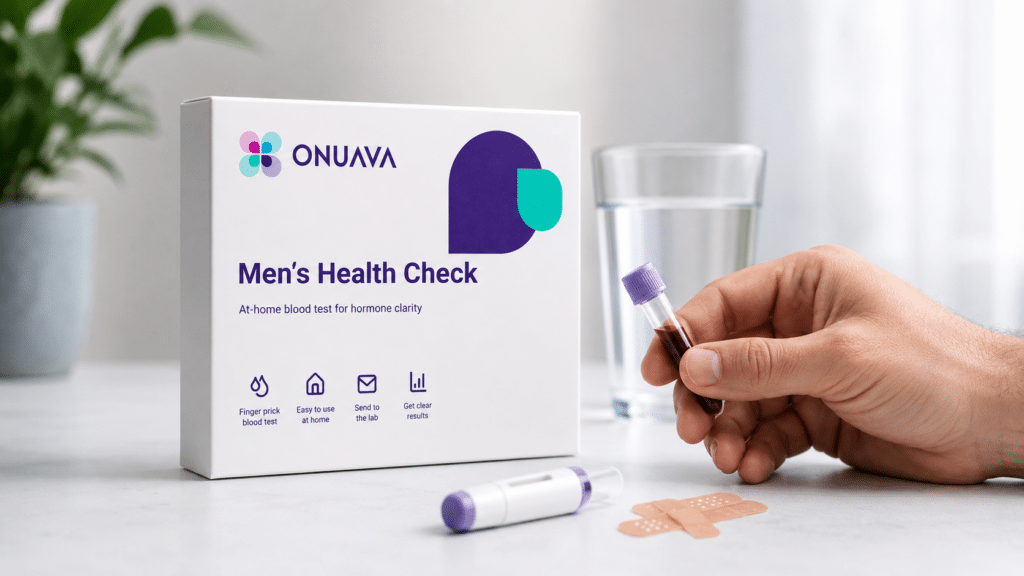
This is exactly where the Onuava Men’s Check comes in. You simply carry out the test at home, and the results are then analysed in a certified medical laboratory. You can then have your results assessed by a doctor and discuss possible next steps.
What is tested as part of the Onuava Men’s Check?
The Onuava Men’s Check assesses key blood parameters relevant to men’s hormonal health. It looks not only at testosterone levels themselves, but also at factors that influence how much testosterone is actually available to the body.
Total testosterone
Total testosterone shows how much testosterone is present in the blood overall. Testosterone is the most important male sex hormone and influences libido, muscle mass, energy, mood, bone health and metabolism, among other things.
A single value should always be considered in the context of symptoms, age, the time of day when the blood sample was taken and other laboratory values.
Free testosterone
Free testosterone is the proportion of testosterone that is directly available to the body. This value can be particularly important because not all testosterone present in the blood is biologically active.
Even if total testosterone is still within the normal range, the available proportion may be lower. This is why looking at free testosterone can be an important addition.
SHBG
SHBG stands for sex hormone binding globulin. It is a transport protein that binds sex hormones such as testosterone in the blood.
Depending on how high the SHBG value is, more or less testosterone may be freely available. SHBG therefore helps to interpret testosterone levels more accurately.
Albumin
Albumin is an important protein in the blood. It also binds part of the testosterone, although less strongly than SHBG.
The albumin value is used to better estimate how much testosterone is actually available to the body.
Prolactin
Prolactin is a hormone that also plays a role in men. Elevated prolactin levels can influence libido, testosterone function and fertility, among other things.
Prolactin can therefore be an important additional value when symptoms such as loss of libido, erectile difficulties or hormonal abnormalities are present.
Why can the Men’s Health Check be useful?
The Men’s Health Check can help identify changes at an early stage and support a better understanding of symptoms. It does not replace a medical diagnosis, but it provides a structured basis for the subsequent medical consultation.
Because symptoms such as tiredness, lack of drive, sleep problems or reduced performance can have many different causes, it is useful not to rely on gut feeling alone, but to check relevant blood values in a structured way.
The Onuava Men’s Health Check gives you an easy way to carry out an important hormonal blood test at home, have it analysed in a certified medical laboratory and then have your results reviewed by a doctor.
Who is the Men’s Health Check suitable for?
The Men’s Health Check can be particularly useful if you notice changes in energy, libido, mood, sleep, muscle strength or concentration. From midlife onwards, it can also be helpful to get to know your own values better and monitor them over time.
Men’s health does not only start when symptoms appear. It starts with taking your own body seriously and understanding changes early.